
Choose Outdoor Chairs That Match Your Climate and Storage Plan
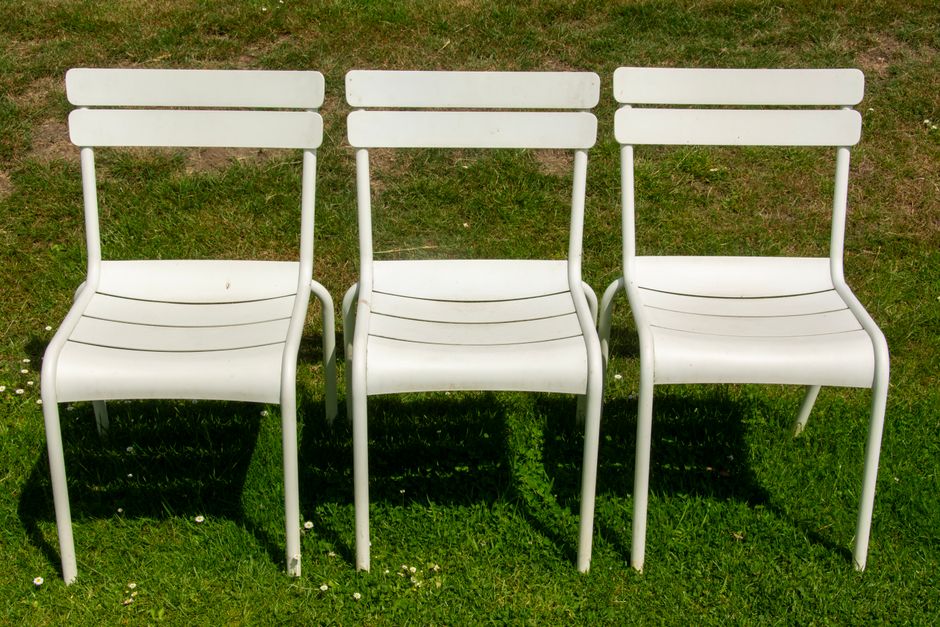
For an affordable chair that stays outdoors, choose resin where easy storage and weather resistance matter, or aluminum where rust resistance matters; choose powder-coated steel only when you will inspect and repair chips. No provided source publishes comparative prices, teak or sling-mesh performance, so shop the specifications, finish condition, cleaning needs, and storage fit rather than a blanket material claim.
What outdoor chair material can be left outside year-round?
Resin and aluminum have the strongest source-supported case for remaining outdoors year-round, provided they are cleaned and maintained; steel needs a sound coating and prompt chip repair. This is the useful distinction: “outdoor” does not mean “ignore it.” It means the material has a maintenance plan.
Iowa State University Extension and Outreach describes plastic resin as extremely durable and weather-resistant, and notes that many resin pieces stack or break down for easier storage. That makes resin the practical option for a small balcony or a household that needs chairs out of the way when they are not in use.
Aluminum resists rust, but Iowa State warns that it can develop pitting and a dull patina. Its operating instruction is simple: wash it regularly and wax it every few months. The Aluminum Association also explains that corrosion resistance varies by alloy series, so “aluminum” alone is not a complete specification. Ask the seller to identify the alloy or finish rather than assuming every aluminum chair performs alike.
Teak and sling mesh belong in the comparison only with a clear limitation: the supplied sources do not publish their weather performance, maintenance needs, or prices. Do not let a broad material label replace product documentation.
| Option | Who it suits | Cost | Key limitation |
|---|---|---|---|
| Plastic resin | Shoppers who need weather resistance and easier storage; many pieces stack or break down. | Not published | Clean with mild detergent and water; Purdue advises against abrasive powders, chlorine bleach, and silicone cleaners. |
| Aluminum | Shoppers prioritizing rust resistance. | Not published | Can pit and develop a dull patina; Iowa State recommends washing and waxing every few months. |
| Powder-coated steel | Shoppers prepared to inspect the finish and touch up damage. | Not published | Coating damage can expose metal to corrosion. |
| Teak | Not published | Not published | Not published |
| Sling mesh | Not published | Not published | Not published |
Do aluminum patio chairs get too hot in the sun?
The provided sources do not publish patio-chair surface-temperature data, so they cannot support a promise that an aluminum chair will or will not become too hot in direct sun. This is a documentation gap, not a reason to guess.
The Aluminum Association states that commercially pure 1xxx-series aluminum has high thermal conductivity, while alloy composition also affects corrosion resistance and other properties. That helps explain why the exact material specification matters, but it is not a tested comfort rating for a particular chair.
Use the specification check before buying: ask for the alloy, the finish, and the seller's published care guidance. For poolside or open-patio use, do not substitute a material reputation for a documented answer about the exact chair. If the retailer does not publish relevant information, public data in the supplied sources does not fill that gap.
Will powder-coated steel patio chairs rust?
Yes, powder-coated steel patio chairs can rust if the coating is damaged and bare metal is exposed, although powder coating reduces the risk of corrosion and weather-related wear. The finish is the barrier. Once that barrier fails, the maintenance task changes.
The Powder Coating Institute says powder-coated products better resist impact, moisture, ultraviolet light, heat, and other extreme weather conditions than conventional finishes. That is meaningful protection, not a lifetime guarantee.
National Institute of Standards and Technology consumer guidance explains that a small bare-metal area, including a chip in a coating, can initiate pitting corrosion. Its practical instruction is direct: cover coating holes with new paint or lacquer. In coastal conditions, wash metal often after exposure to salt or sea air and avoid salt-water exposure when possible.
Run the chip check before a sale purchase. Look over edges, joints, feet, and any area where the finish is broken. “Powder-coated” is not the finish line; “powder-coated and intact” is the condition you are buying.
Build a Chair Plan Before You Buy
Shopping goes faster when each chair has a job. For a compact balcony, prioritize the documented stackable or break-down advantage of resin. For an open patio, decide whether you will actually perform the washing and finish checks the material requires. For a coastal setting, treat regular washing after sea-air exposure as part of ownership, not an optional extra.
For cushions, skip vague assumptions. Purdue University Extension recommends spot-cleaning acrylic, polyester, and cotton outdoor cushion fabrics with liquid dishwashing detergent and lukewarm water, then rinsing and air-drying. That guidance supports a care routine; it does not establish that every outdoor cushion is waterproof.
Before checkout, ask for the dimensions, weight limit, warranty, and delivery terms in writing. The supplied sources do not publish universal values for those items. For a plastic chair, ask whether it is evaluated against ASTM F1838. The standard covers weathering, impact, static-load, and rear-leg testing for plastic outdoor chairs, but it does not apply to chaises, multipositional chairs, upholstered chairs, or every other furniture type.
Here is this week's drill: measure the space, list the chair's exposure to sun, moisture, and sea air, then write one maintenance action you will actually do. Buy the chair whose care plan fits that list. That is how an affordable chair stays affordable.
Frequently Asked Questions
Are outdoor cushions waterproof or only water-resistant?
An outdoor label alone does not establish that a cushion is waterproof. Purdue University Extension gives cleaning instructions for acrylic, polyester, and cotton outdoor cushion fabrics, including rinsing and air-drying, which makes material-specific care the safer assumption. Check the product documentation for its stated water rating.
What should I look for when outdoor chairs go on sale?
Check the chair's published dimensions, weight limit, warranty, delivery terms, material, coating condition, and care instructions before treating a sale as value. For plastic chairs, ask whether the manufacturer identifies ASTM F1838 performance testing; the standard addresses weathering, impact, static load, and rear-leg testing, but it does not cover every chair type.
How can I tell whether a patio chair will fit on a small balcony?
Measure the usable balcony area, then compare it with the seller's published chair dimensions and the space required to pull the chair in and out. The supplied sources do not publish a universal balcony-clearance rule. Prioritize stackable or break-down resin options when storage flexibility is part of the constraint.